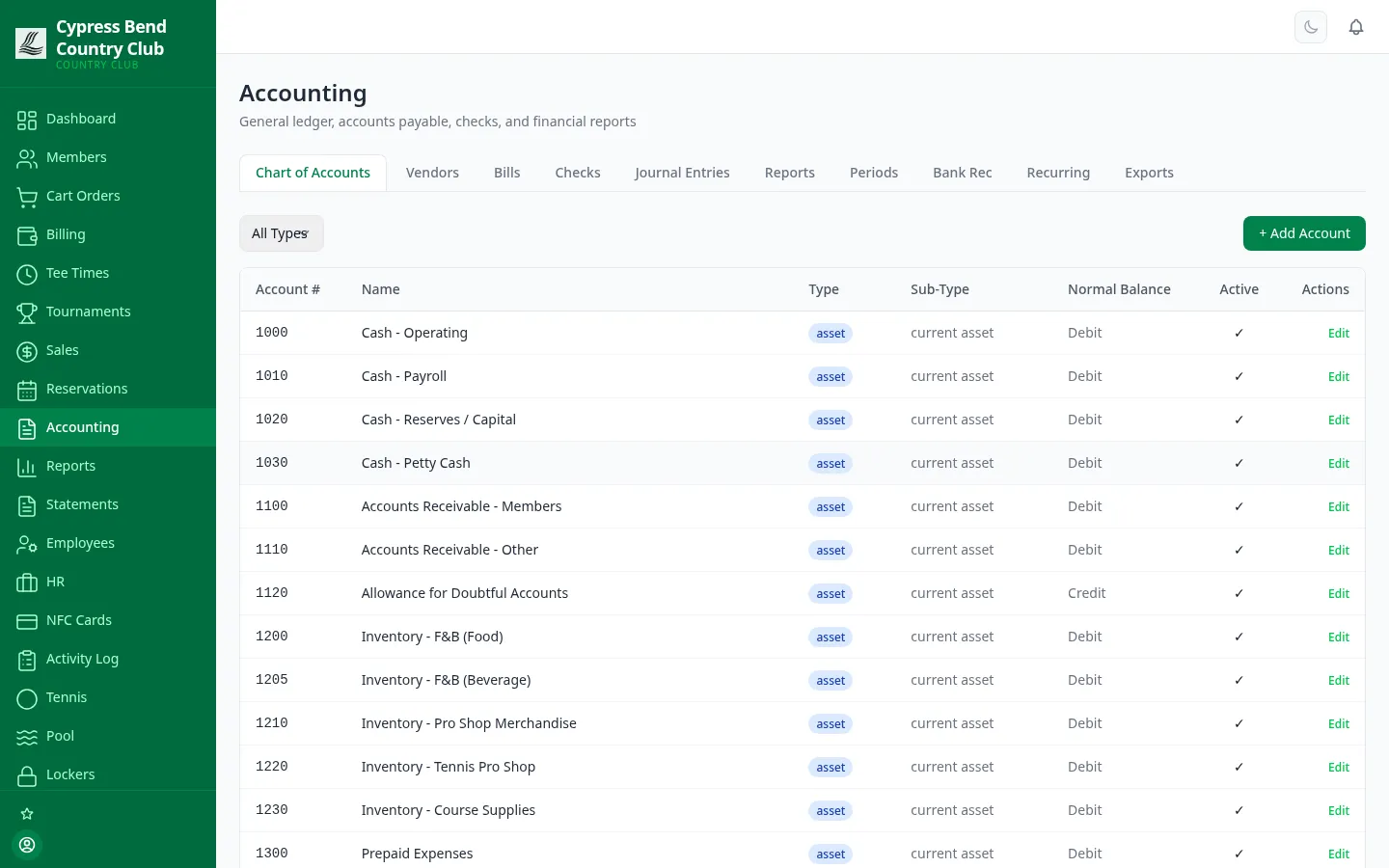
ClubCore runs a true double-entry GL inside the same system as the register, the tee sheet and member billing — so POS sales, member charges and amenity fees post their own journal entries, and every posting traces back to the ticket that created it.
One Accounting page, ten tabs, no re-keying. Accounts organized by Assets, Liabilities, Equity, Revenue and Expenses, with subaccount hierarchy and balance tracking on every account.
Chart of AccountsVendorsBillsChecksJournal EntriesReportsPeriodsBank RecRecurringExports
The USFRC chart, pre-seeded
Seed your chart of accounts from the Uniform System of Financial Reporting for Clubs (7th edition) — the industry-standard club chart — and preview it before anything is created. Already have a chart? Run the USFRC compliance audit to see how it compares.
Posted means posted
Journal entries save as drafts you can still edit — but once posted, an entry is a permanent ledger record. Voiding never erases history: ClubCore posts a balancing reversal, and both sides land in the audit trail.
Periods that actually lock
Close a month and nothing can post into it. Soft-close a period under review, reopen one when a correction genuinely must land there, and run the year-end close to roll net income into retained earnings.
Statements on demand
Trial balance, income statement and balance sheet for any period — plus a UBIT report that tracks nonmember revenue for 501(c)(7) clubs that need it for tax reporting.
The operation posts itself
POS sales and member billing create their own journal entries, and charges from events, fitness, camps, lockers, tournaments, lessons and the pro shop post through A/R into standard USFRC revenue accounts — re-routable per category to the accounts your club actually uses, without a code change. Manual entries are for adjustments and transfers, not for keying the day in.
Accounts payable
From a stack of invoices to a stack of checks
Bills move through a controlled lifecycle — draft, open, paid or voided — with aging buckets from Current to 90+ days so overdue is never a surprise.
The check run
Batch in, checks out
Key a week of invoices as one validated batch — ClubCore flags any bill matching an existing vendor and invoice number, so the same invoice can’t get paid twice — then pay and print in one pass.
1
Key bills in a batch
validated before saving, with duplicate detection on vendor + invoice number
2
Pay open bills together
one check run — each vendor’s bills produce a check in the print queue
3
Print onto check stock
QuickBooks-compatible voucher stock, with a calibration page for alignment
4
Confirm, or void & reissue
checks are marked printed only after you inspect the stock
A misprint isn’t a mess. Void & Reissue cancels the damaged check and drops a fresh one back in the print queue — and a facsimile mode draws the whole check on plain paper for test prints and record copies.
Vendors, on file
A registry of everyone the club pays — suppliers, utilities, service providers — with bills, checks and purchase orders all tied back to the vendor record.
Bank rec that carries forward
Tick ledger items off against the monthly statement, add adjustment entries for bank fees and interest, and complete when it balances. Outstanding checks and deposits in transit carry into next month automatically.
Recurring entries
Templates for depreciation, accruals and rent post on their own schedule. Preview shows exactly what a run would post before anything touches the ledger — or skip an occurrence entirely.
QuickBooks & payroll exports
Map GL accounts to QuickBooks names once, then export the journal as IIF (Desktop) or CSV (Online), plus payroll roster and hours files for your payroll provider. Every export is logged — who pulled what, and when.
Purchasing
Low stock to vendor bill, hands off
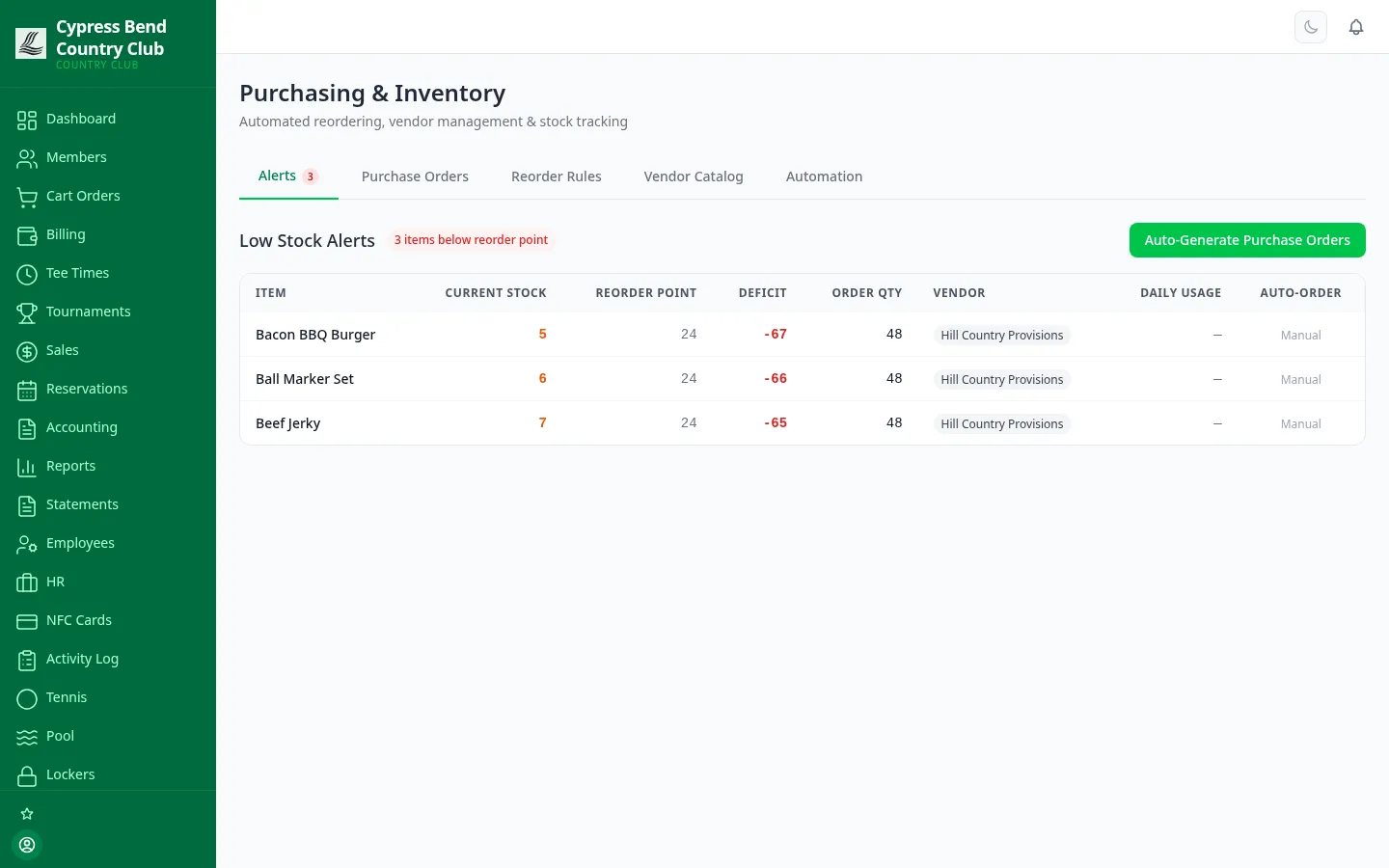
Per-item reorder rules set the low-stock threshold, the reorder quantity and the vendor. When stock dips below the line, an alert fires — and the automation loop can draft the purchase orders, submit them, receive the stock back into inventory and generate the matching vendor bill straight into Accounts Payable.
Auto-numbered POs with a controlled lifecycle: draft → submitted → received
No skipped steps — and received quantities can’t exceed what was ordered
A vendor catalog of who supplies what, with usage rates informing suggested quantities
Receiving closes the loop: stock into inventory, bill into A/P
app.clubcorehq.com/purchasing
Purchasing & Inventory — reorder alerts, purchase orders and automation
Tax, configured per club — not per keystroke
There’s no single flat tax-rate field to outgrow. Each club configures tax categories carrying one or more rates, every item is assigned a category, and the register computes each line’s tax from it — with Tax Collected surfaced as a dashboard KPI.
Boards & accounting firms
Built for the boardroom, and for the firm behind it
Capital reserve planning answers the board’s hardest question — are we saving enough for the roof, the greens and the fleet — and hub mode gives the accounting firm managing several clubs one consolidated set of books.
A 10-year reserve forecast
Track reserve components on standard useful-life conventions, manage reserve funds and their transactions, and project funding a decade out — the numbers a reserve conversation should start from.
The Eight Financial Warning Signs
ClubCore checks the club’s reserve position against the Eight Financial Warning Signs of underfunding, so the board sees trouble as a named, explainable flag — not a surprise in year six.
One screen for the whole firm
Hub mode consolidates every connected club: total members, cash, A/R and A/P, YTD revenue against expenses, and consolidated trial balance, income statement and balance sheet — with a per-club drill-in and per-club sync.
Who owns the books is enforced
When the firm owns a club’s books, the club-side ledger tabs — chart of accounts, journal entries, periods, bank rec, checks — go read-only. The firm makes those entries; the club can’t accidentally post over them.
See it live in 15 minutes.
We'll hand you a personal sandbox seeded with a full club — menu, members and three years of books — then walk your team through it.